PLEASE POST A COMMENT....!

Post your Signature on any entry..Thank you.
Mostrando entradas con la etiqueta PANZER CAMPAIGNS. Mostrar todas las entradas

martes, 21 de febrero de 2012

HPS PANZER CAMPAIGNS - MARKET GARDEN '44


Les presento este apasionante título de HPS: Panzer Campaigns Market-Garden '44; recomendada especialmente para aquellos que se agoten hasta la extenuación con turnos eternos y extensísimos mapas de otros títulos; aquí tendremos una campaña más corta, más ágil y con escenarios llenos de glamour paracaidista...


La Wikipedia nos cuenta:

"La operación Market Garden (17 al 25 de septiembre de 1944) fue la mayor operación aerotransportada de las Fuerzas Aliadas durante la Segunda Guerra Mundial, cuyo objetivo táctico era capturar una serie de puentes sobre los principales ríos de los Países Bajos (bajo ocupación alemana). La operación fue también el mayor fracaso militar de los aliados en la contienda con Alemania.

La ocupación se planeaba hacer con fuerzas aerotransportadas combinadas con unidades blindadas terrestres. Una vez ocupados estos puentes, se crearía un corredor a través del cual las fuerzas aliadas podrían cruzar el río Rin, la última barrera natural antes de entrar en Alemania. El alcance de la Operación Market Garden la hace comparable con el desembarco de Normandía. La Operación estaba planeada para dar el golpe definitivo a Alemania que pusiera fin a la guerra en 1944.

Los aliados consiguieron tomar exitosamente los primeros puentes, pero el resultado global de la Operación fue un rotundo fracaso, al no poder ocupar el puente final en Arnhem. La contraofensiva alemana destruyó la 1ª División Aerotransportada Británica, además de causar más bajas en los Aliados que las que tuvieron durante la invasión de Normandía. La derrota aliada es considerada la última de las grandes victorias tácticas del Tercer Reich en la campaña occidental y alargó la guerra en Europa casi un año más."


- 1 hexágono representa un kilómetro, y 1 turno representa 2 horas, con un mapa de aproximadamente 120 por 40 kilómetros. Más de 880 unidades representan las fuerzas alemanas y aliadas, a nivel de batallón y compañía.

- La unidades disponibles abarcan desde unidades de reconocimiento a blindados, artillería, infantería, paracaidistas, ingenieros, antitanques, antiaéreos, y una amplia variedad de otras unidades especializadas.

- 35 escenarios históricos además de varios escenarios "¿que pasaría si...?". Hay seis escenarios de campaña, con zonas alternativas a las históricas para las tropas aerotransportadas.

- Actualizado a la versión 1.05, e incluidas las mejoras gráficas de Volcano y las de MapMod.

Requisitos:

- 200mhz Pentium

- 32 megabytes de RAM

- 250 Mb de espacio en disco

- Windows 98/2K/XP

- Win95 no es compatible.


Decomprimir el archivo .rar y ejecutar el "MarketGarden44.exe"

Links:


http://rapidshare.com/files/449171469/redoute_mg44.rar

ò

http://www.mediafire.com/download.php?9sowxk5fkcfbntk


Manual en castellano de la serie Panzer Campaigns:

http://rapidshare.com/files/44891741...astellano_.doc

Ya no hay escusa, esta sí que es fácil de jugar ehhhh...

lunes, 20 de febrero de 2012

HPS PANZER CAMPAIGNS - TOBRUK ´41


Les presento otro título de HPS perteneciente a su serie Panzer Campaigns, Tobruk '41 que cubre el Afrika Korps de Rommel y la lucha por Tobruk contra el 8 º Ejército británico, durante la 2ª Guerra Mundial.
El juego incluye las operaciones de Battleaxe y Crusader, así como los ataques a Tobruk.

Como es mi costumbre, la Wikipedia nos cuenta:
"La Operación Battleaxe (15 de junio - 17 de junio de 1941) fue el segundo intento, fallido como el primero, para liberar Tobruk del cerco a que el Afrika Korps del general Rommel le había impuesto. El comandante de las fuerzas inglesas era el general Noel Beresford-Peirse, que contaba para ello con el XIII Cuerpo de Ejército, la 7ª División blindada y la 4ª División india. Rommel contaba con la 5ª División ligera y con su famosa 15ª División Panzer.
Peirse planeó el ataque frontal por parte de la División india a las posiciones en torno al Paso de Halfaya y al fortín de Capuzzo, mientras que las fuerzas acorazadas, después de tomar el puente de Hafid, atacaban a los Panzers. Pero los ingleses infravaloraron las fuerzas al mando del Zorro del desierto, y no sabían que éste contaba con la 15ª División Panzer, una división altamente adiestrada, con gran número de carros Panzer IV y con una enorme reserva de antiaéreos de 88 mm, que los alemanes usaban como potentísimos cañones antitanque. La operación fue un total fracaso: los británicos tuvieron casi 1000 bajas y perdieron 91 carros de combate y 36 aviones, por tan sólo 700 bajas alemanas, con 12 tanques y 10 aviones perdidos. A pesar de esto, en el siguiente intento (Operación Crusader), las fuerzas inglesas consiguieron desaolojar temporalmente a Rommel y liberar Tobruk.

La operación Crusader (18 noviebre - 30 diciembre 1941)fué el tercer intento durante la Segunda Guerra Mundial para romper el Sitio de Tobruk, en la costa africana del Mediterráneo, al que tenían sometidos los alemanes a las tropas inglesas. La operación tenía como objetivo detener definitivamente el avance del Afrika Korps del general Rommel. Su resultado fue la derrota alemana y la liberación de Tobruk, pese a que a los pocos meses Rommel contraatacó y consiguió finalmente tomar el disputado puerto norteafricano."


-1 hexágono representa 1 km y 2 turnos 1 hora; con un mapa que mide más de 160 por 110 kilómetros. Más de 1000 unidades representan el Afrika Korps y el Octavo Ejército británico, principalmente a nivel de batallón y compañía.

-Podermos manejar unidades blindadas, de reconocimiento, artillería, infantería, paracaidistas, ingenieros, antitanque, antiaéreo, cohetes, cuarteles generales, y una amplia variedad de otras unidades especializadas.

-Los escenarios van desde una serie de 51 escenarios y 7 escenarios de campaña.

-El juego está actualizado a la versión 1.08, incluyendo los mapas de Mapmod, las unidades de Volcano y algunas unidades propias (polacos, algunos italianos, alguna alemana y alguna aliada, además del logo de Rommel, cambiado por el simbolo del Africa Korps) cuyas versiones originales han sido renombradas como "_old" por si alguien quiere recuperarlas.

-Descomprimir el .rar (124,92 Mb) y ejecutar el "Tobruk41.exe"


Requisitos:
-Pentium 133MHz + PC con 32 megabytes de RAM.
-250 MB de espacio en disco duro
-Windows 98/2000/XP operativo.


Links:
http://www.mediafire.com/download.php?w57xrpdj8917tad

Manual en castellano de la serie Panzer Campaigns:
http://rapidshare.com/files/44891741...astellano_.doc


La lucha en el desierto siempre tuvo un "atractivo especial"... salvo por los escorpiones, la arena, el clima extremo, las minas, etc, etc...

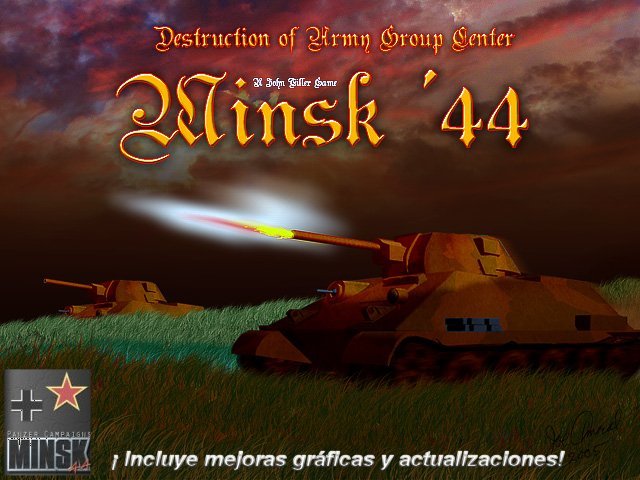
HPS PANZER CAMPAIGNS - MINSK '44

 
Gracias a HPS en este título de su serie Panzer Campaigns, podemos ponernos en la piel del poderoso Ejército Rojo o bien resistir su acometida si nos ponemos del lado Alemán, en la Operación Bagration durante la 2ª Guerra Mundial.

La Wikipedia dice:
"El 22 de junio de 1944, tres años y un día después de la invasión alemana de la Unión Soviética, el Ejército Rojo lanzó una ofensiva en masa sobre la RSS de Bielorrusia. La ofensiva, con el nombre en clave de Operación Bagratión, condujo a dañar al Grupo de Ejércitos Centro Alemán y alcanzó su clímax cinco semanas más tarde, cuando el Ejército Rojo llegó a las puertas de Varsovia. La operacción supuso la total destrucción del Grupo de Ejércitos Centro Alemán. Un total de 17 de sus Divisiones fueron golpeadas y más de 50 dañadas. Fue la más calamitosa derrota de las fuerzas alemanas de tierra durante la 2ªGuerra Mundial y le costaría muchos más hombres y material que la debacle de Stalingrado 16 meses antes."

http://es.wikipedia.org/wiki/Operacion_Bagration

- Hay 42 escenarios, incluyendo el asalto principal Soviético que lanzó el 23 de junio en el norte y el 24 de junio, así como los primeros trece días de la ofensiva y avance hasta el momento en que el impulso ofensivo se pierde; además incluye pequeños escenarios tipo "¿qué pasaría si".
- Novedades como las nuevas unidades partisanas.
- Instaladas la mejoras gráficas MapMod y las de Volcano.
- Incluidas las ultimas actualizaciones a la versión 1.02.


domingo, 18 de enero de 2009

THE WEHRMACHT STRATEGY.

An Operational Level Analysis of German Armed Forces Defensive Tactics inHPS Simulations Panzer Campaign Series or"Nicht kleckern, klotzen!" ("Don't tickle, smash!")(1).

Photobucket

Armed forces in modern times exist, fight and die on their military doctrines. Contemporary history from 1900s onwards has no battles where organized armies clashed on battlefields at the whim of individual commanders. A shared way of thinking, military doctrines define and rationalize the existence of an armed force, its operational procedures, techniques and finally the relationship between national strategy and unit-level tactics.
The aim of this article is to create a guideline for HPS Simulations Panzer Campaigns®players in their efforts to guide Wehrmacht to victory on defensive missions.To understand the notion of “defense” as perceived by Wehrmacht, I think it is necessary to elaborate on the operational guidelines that it followed during WW II.
On the strategic and operation level, German Armed forces doctrine was shapes around the idea of Blitzkrieg. I will not dwell on the details of the Blitzkrieg tactics, since they focus primarily on offensive operations. However, certain keystones of the Blitzkrieg have shaped the formation of Wehrmacht units in general.

Schwerpunkt
Blitzkrieg sought decisive actions at all times.
To this end, the theory of a Schwerpunkt (focal point) developed; it was the point of maximum effort. Ground, mechanized and Luftwaffe forces were used only at this point of maximum effort whenever possible. By local success at the Schwerpunkt, a small force achieved a breakthrough and gained advantages by fighting in the enemy's rear. Naturally, the selection of the point of maximum effort depended largely on reconnaissance. In the HPS games this is somewhat easier since at the beginning of each game both sides have perfect information about the enemy’s troop dispositions and unit details.
Paralysis
Having achieved a breakthrough into the enemy's rear areas, German forces attempted to paralyze the enemy's decision making and implementation process. Moving faster than enemy forces, mobile forces exploited weaknesses and acted before opposing forces could formulate a response. Guderian wrote that "Success must be exploited without respite and with every ounce of strength, even by night. The defeated enemy must be given no peace."
Kesselschlacht
An operation's final phase, the Kesselschlacht (cauldron battle), was a concentric attack on an encircled force. It was here that most losses were inflicted upon the enemy, primarily through the capture of prisoners and weapons.Naturally, such concepts shaped the formation, equipment, deployment and finally operations of German land and air units.
UNITS AND THE PHILOSOPHY BEHIND THEIR ORGANIZATION
The building block of German land forces was the infantry arm.Between 1939 and 1943 the German standard infantry division contained three regiments with a total of nine rifle battalions. Each of the infantry regiments had, besides its twelve rifle and heavy weapons companies, a 13th (infantry howitzer) and 14th (antitank) company. The division had also an antitank and a reconnaissance battalion. Organic artillery consisted of one regiment of one medium (150-mm. howitzer) and three light (105-mm. howitzer or gun) battalions with a total armament of forty-eight pieces.
In October 1943 the division was drastically overhauled to reduce its size while maintaining its firepower. Organization charts of the new-style division (with 13,656 men) comprising three regiments of two battalions each had only just been published when further slashes were ordered.
The result was the so-called 1944-type infantry division with an authorized strength of 12,769 men.
The change from 1943 onwards has also affected the combat capabilities of German Infantry Divisions. Reduced personnel strength and the resulting equipment reorganization created formations that retained their original firepower with less men. This of course resulted in the abolishment of the standard practice of keeping divisional reserves behind the Main Battle Zone.Thus, we need to make a distinction between pre-1944 and post-1944 titles in the sense that the defensive strength and manpower of Infantry Divisions will differ significantly and effect game play and tactics.A point however, remains the same.
The Wehrmacht Infantry Divisions are created with the idea that their primary battlefield role would be to combat other infantry formations, liquidation of enemy troops in pocket reductions or frontline holding roles.
Thus, in HPS titles –as it was in real life- an Infantry Division will mostly have only an organic Strumgeschütz Battalion and some FlaK units as mobile elements.
Let us analyze the deployment of a standard 1944 Infantry Division on the field.In HPS games a typical (book strength) German Infantry Division in 1944 is composed of:
3 Infantry Regiments (each regiment consisting of roughly 1000 men)
1 Fusilier or Grenadier Battalion (roughly 400 men)
1 Panzer Jager Abteilung (12 A/T guns)
1 Artillery Regiment (made 48 guns)
1 Pioneer Battalion (roughly 400 men)
1. F.E. Battalion (roughly 350 men)
Total: 4000-5000 men.
Remember that this is a book strength establishment and there were Infantry Divisions defending the front at half their establishment strength or with a compliment of an attached Battalion or Regiment for a total of 6000 men.
This establishment and the composition of a division reflects the philosophy that has remained constant in Wehrmacht thinking from the outset of the war. Even as late as 1944 Infantry units were regarded as responsible for line holding and not mobile operations.
On the other hand, keeping in line with the idea of Blitzkrieg, Wehrmacht created mobile infantry units to keep pace with Panzer Division and conduct offensive encirclement operations.
These units were either Motorized Infantry or Panzergrenadier (Armored Infantry) divisions.
DEFENCE AGAINST MOBILE ENEMY OPERATIONS
Now that the basic philosophy and composition of Wehrmacht Infantry units have been established, we will move on to analyze the possible methods of mobile operations involving division/corps sized units.In my earlier article explaining the employment of Infantry Regiments on the battlefield, I had analyzed various battlefield deployments of Infantry units on the defense. Some points are worth mentioning once again:
1 – Always position and employ your units in as combined a way as possible. Try not to position single companies in the front line if there is a possibility to combine 2-3 companies together. Fatigue incurrence is negatively correlated with unit size.
2 – Try to keep Heavy Weapon companies at least 1 hex behind the front line. Their indirect fire capability and generally high soft attack ratings make Heavy Weapon companies valuable support units.
3 – Prefer woods to plain ground, Cities to woods, Industrial areas to cities. Check elevation and remain on higher ground whenever possible.
When the enemy unit attacks, and if the enemy has mobile elements (tank regiments/battalions) proper utilization of such resources will allow the enemy to penetrate your front line.That should not be a cause for concern at the initial stages. Remember that sustaining the offensive will prove to be much tougher than the defense.
Your opponent will need to consider strengthening and keeping the momentum of his offensive as well as checking for his flank security and maintaining a balance between the penetrating units and his frontline units keeping up the pressure.
The crucial point when your front line is penetrated is to recognize the axis of enemy operations, and the units the enemy is utilizing in his operations.
If you are unable to contain the penetration with units immediately behind the penetration point (at most 10 hexes), than it is time to switch to flexible defense and retreat in an orderly manner.
While retreating, the important points to remember are:
1 – Use of littering: This tactics calls for leaving some small units in the rearguard as the main body of your army retreats under enemy pressure. Always keep units on roads, whether they are primary or secondary. Remember that enemy units will not be able to pass between units maintaining a separation of up to 2 hexes. Try to place AT guns, Inf. Guns or company sized units in the rear in extended line formation. I have just been reminded by Bill Brockman that AT guns no longer project Zones of Control. Thus it is necessary to place another unit in the same hex with the AT gun while littering. While your enemy tries to grind these littering units, move in an orderly manner to the next best defensible terrain.Remember here that unless disrupted your infantry units will move as much as the enemy infantry units. Try not to engage in direct fire battles but retreat and keep the army on the field.
2 – Mobile stopgaps: In corps size unit formations, you will likely have StuG and Pioneer units that have greater mobility than your infantry units. Your StuG units are especially valuable here since they are counted as Hard Units, therefore reducing the damage they will take from enemy infantry units. Try to leave the StuGs rather than anything else in direct contact with the enemy if it is imperative to leave some sort of unit in the direct front line. Unless they are assaulted, your StuGs will live to see the next turn. It is best not to leave anything in direct contact with the enemy if possible. Flak guns, pioneers and Self Propelled artillery units can also be used in such screening roles.
3 – Isolation: A unit that is isolated will likely be destroyed. Try to keep 1 unit that shares a hex boundary with your units that will be isolated in the next turn. This will allow your isolated units to retreat at the cost of full movement points but live 1-2 more turns and block the enemy.
4 – Frontline: Even when your front is penetrated, keep in mind that you have the advantage of intelligence. Your enemy is moving through an area with no knowledge of what lies ahead. You on the other hand, will be able to keep track of the units passing through the gap in your front lines.
Try to hold the flanks of the penetration to a certain extent, and limit the size of the gap in your front lines. Your best efforts should be concentrated not to immediate counterattack but to maintain the flanks and extend defensive positions to the flanks of the penetration.
This should turn your front line into a V shape with the point indicating the area of enemy penetration.
Whenever possible try to contain the enemy penetration and gap blown through your lines to as small a line as possible.
ON TO THE OFFENSIVE
"Nicht kleckern, klotzen!" ("Don't tickle, smash!")
We have discussed about various methods to contain enemy penetrations until now. In this section I will try to outline the basic methods to prepare and launch an offensive against enemy penetrations.For the purposes of our study, I will assume that we have a Korps size unit under our command.
This will normally be possible in medium to long scenarios with enough map space for maneuvering.In Korps size operations, you will normally have 2-3 infantry divisions and 1-2 Panzer Divisions. Infantry divisions will most likely be in the front line with the Panzer Divisions located some 10-30 hexes behind.
You will normally also have Korps level assets under your command; StuGs, 88 mm AT guns, AA guns etc.With the enemy moving through the gap in your front line, the first matter is to establish and recognize an area of counterattack. The area of operations should favorable have as little defensive cover as possible.
Open ground will impair your enemy’s ability to defend against your moves by utilizing natural cover and built up areas, and help your units to utilize their movement factors as much as possible.
Depending on unit dispositions on the map, prefer either of the below methods for counterattack:
1 – Pincer movement: In this method, your mobile divisions should be located on either side of the enemy penetration.
Once the enemy Infantry units start to move through the gap, than you can realize that all mobile elements are already behind your lines.
Strike in concentric waves first to seal the gap, and than with one division turns to engage the penetrating enemy units, while holding the line with the second division.
Utilize Korps level assets to block enemy penetrations further back and form the base where your attacking unit will sweep enemy units.
Try to include the armored-especially Panzer- battalions of the defending Division alongside this attack to possess maneuverability.
HPS Games example:
German summer offensive in Kharkov ’42.2 – Bandwagon:
In such a case where you may find your Panzer divisions placed behind each other, the logical way to utilize them would be to use one to seal off the gap the enemy has torn, and the other to hit the flank of the enemy, causing your opponent to reverse the attack and track back to engage you. It is crucial to refrain from extending your units in line formation along the enemy’s penetration and engage your opponent along a wide frontage.
Remember the philosophy with which your units were created. Schwerpunkt gains its true meaning is such operations as in this case.
Focus on the objective (1 - sealing off the gap, 2 engaging the enemy’s flank) and use your units accordingly. Remember that a 10 hex gap takes 1-2 turns to seal if you can catch the enemy off balance.
After that the enemy units will be “Isolated” and in 1-2 turns low on fuel and ammunition. These will effect its Morale Rating and ability to fight. Restrain yourself and wait for these 1-2 turns to pass. Your opponents units will have to backtrack and try to establish a link with the units bringing up his rear. In such a disorganized manner, they will be easy to isolate and liquidate with your mobile units.
It will take an extremely aggressive and disciplined opponent to continue the advance and try to re-open the gap with the following units.
HPS Games example:
German Counter attack in Korsun ’44 to relieve the encircled forces in the Cherkassy pocket.3 –
Hammer and Anvil: This is the third case where you have one Division on the side of the penetration, and another placed roughly in front of the enemy advance. In such a case, as with the first two scenarios, your primary aim should be to cut off the penetration. Attack with one Division to seal the gap in your lines. Meanwhile, move your second division in front of the enemy movement axis. Once the gap has been closed, attack with the blocking division towards your lines. Your Korps level mobile assets can form loose screens to prevent enemy counter flaking moves. Press forward with the main body of your division, while disengaging mobile units from the first division holding the line. Under normal circumstances this should allow you to possess enough units to encircle the enemy. Keep up the pressure on one side while containing enemy escape from “the bag”.
HPS Games example:
German winter counterattack in Korsun ’42, especially Gold Flashing Sword of Retribution scenario.
PRIMARY POINTS TO CONSIDER
1 – While better equipped and trained than Allied forces, Wehrmacht units are not ultra weapons. Under normal circumstances, a Wehrmacht operational size unit – Regiment or bigger- should be able to withstand attacks from and enemy force twice its strength without significant problems. All of the above analysis and examples have been expressed in the light of at most 1:3 force ratio in favor of your opponent. Any bigger than that, the only possible method of maintaining your forces will be to perform a mobile and ordered retreat, this time utilizing mobile elements and Panzer Divisions and fire brigades to seal off local penetrations. Any ratio greater than 1:2 in mobile elements will make mobile counteroffensive operations very hard to accomplish. Remember that Wehrmacht units normally have higher overall morale ratings and this allows them to incur more fatigue without being disrupted. Try to balance this advantage against enemy’s numerical superiority.
2 – When on the defensive, try to disrupt enemy units with your artillery and Heavy Weapons companies. When you manage to disrupt an enemy unit, move on to the next unit and do not waste any more fire on the disrupted unit. A disrupted infantry unit can move 1 or 2 hexes at most, and this will be less than your undisrupted units. Disruption will allow you to disengage with no losses. Another advantage of enemy disruption is to prevent the enemy from assaulting and flanking your units. Disrupted units can only engage your units in direct fire mode, and their fire values are decreased because of their disrupted state.
3 – Always keep your units within command distance of their respective higher Headquarter units. Never place and waste your HQ units in the front line.
4 – Your air units are most effective in disrupting enemy staging area units. Try to locate enemy units in T mode with your reconnaissance planes and hit them while they are in T mode. If used effectively this will disrupt enemy staging operations and you will lose less airplanes when compared to using them in front line support roles. Expect with good players, you are most likely to locate enemy units in T mode 3-15 hexes behind enemy front lines.
5 – Pictures showing unit deployments discussed in the article will be available shortly.Kind regards

Exploitation in Panzer Campaigns.

This article will focus on exploitation phase of mobile operations in the PzC series. It will be narrated primarily form an attackers viewpoint. Please note that most of the information here is useful and relevant for 40+ turn scenarios or campaign games.PzC series campaign games can be divided roughly into two phases.
The first phase is the High information phase, where both sides have perfect information about each others troop dispositions, unit strengths and axis of movement/atack. This picture starts to lose coherency after approximately 15-20 turns, mostly in favor of the defender.The second phase is the Low information phase, where the defender usually monitors the attackers forces by use of withdrawing units. However the attacker loses track of some of the defenders units, especially his mobile counter attack reserves. This is the most dangerous time when the attacker tries to press his attack and achieve his objectives, AND also monitors the defenders counter attack forces concentration and movement.It is possible for the attacker to reverse, or at least alter this picture by rapid elimination of the defenders initial line of defence and starting mobile exploitation battle in enemy rear areas.
PHASE I : HIGH INFORMATION PHASE.

Photobucket

As I have outlined above, this phase starts with the first turn, and usually continues for the initial 15-20 turns. This is the stage where as the attacker you will have the most advantageous position. The enemy troop positions are fully within your knowledge and usually LOS, and it is possible to break through the enemy front lines with minimum delay.
There are some primary points to consider and keep in mind at this stage.
1 – Plan your assault carefully. Remember that the game you are engaged in is a long scenario. It will take from 50 to 300+ turns to play and complete this game.
Try not to allow any of your units to be completely eliminated. Even a single digit unit will recover provided it is given enough time.
2 - Before starting your assault on enemy front lines, define your assault/breakthrough forces and the exploitation forces. Prefer mobile troops, tanks, and cavalry as your exploitation force. Try as much as possible, not to engage the exploitation force in breakthrough attacks.
3- Do not push the enemy back on a broad front. Remember that time and force strength are essential for future turns. The enemy will not be in a position to lauch a counterattack in the first turns. Therefore, concentrate your infantry divisions facing the enemy front, and attack on a 3-4 hex front with full effect. Try to breach the enemy line with a <>
4 – Press forward with your armored units deep into the enemy’s rear area. In most scenarios this will be free of enemy units for the first 15-20 turns. If you can manage to break the initial line of defence within 5-6 turns of game commencing, this will give you 9-10 turns of free time to establish your surprise dispositions for the enemy.
5- Most players are inclined to encircle the enemy with armored units because of their rapid movement capability. In the long run this tactic allows the destruction of the great part of the enemys first line of troops. However, in doing so you are allowing your greatest assets to be tied down; namely your armored troops.
6 – Try to isolate the enemy in a loose “bag”. That is to say, do not encircle the enemy by placing units 1-2 hexes behind him. Try to use such semi-mobile units as AA guns, or AT units to form the bag, and squeeze the enemy by frontal attacks. Your armored units and the accompanying armored/motorized units need to be kept free of engagement for future employment agains enemy secondary formations and counterattacks.
7 – Since the game will provide you with a clear picture of where enemy mobile reserves are located, you will be able to guess with a high degree of accuracy about enemy counterattack directions. Keep your armored units fluid –do no use them to attack positions in enemy rear- and once the enemy counterattack starts envelop the counterattacking enemy forces in a greater “bag”. Isolated units will very rapidly become low on fuel and ammunitions, and become much easier to disrupt, allowing your units to finish them off with direct assaults.
PHASE II : LOW INFORMATION PHASE.

Photobucket
Once the game progresses beyond 15-20 turns, and the initial enemy stop-gap measures are disposed of, the game will enter the low information phase. From then on, you as the attacker will have limited information about enemy troop dispositions, and numerous enemy reserve formations. There are some primary points to consider and keep in mind at this stage.
1 – Bear in mind objectives, and enemy supply points. Capturing any enemy supply points will effect enemy units very adversely, and create supply level drops in enemy forces. You will begin to notice many enemy units unable to fire effectively, or move far once supply points are severed.
2 – Air recon is useful for deep reconnaissance. Use your aircraft on primary and secondary roads to detect enemy movement. Your enemy will usually prefer to use primary roads for ease of transportation and become predictable.
3 – Assign a clear objective for your maneuver elements. Use your forces with a maximum effect, and try to maneuver around the enemy. Prefer isolation over direct fire. Eventually your infantry, or mechanized infantry will catch up and allow you to clear the enemy positions.
4 – Use armored units for reconnaissance alongside with armored cars. Your forces in the enemy rear area that are free roaming are a great hazard to the enemy. They are available for isolation of enemy single units, and blocking primary roads to disrupt enemy troop movement. Once your units engage in direct firing, the enemy will know where and how strong you are. Deny knowledge to the enemy, while using your mobile troops for information gathering.
5 – Try not to use artillery or air strikes on objectives located on primary roads or road junctions. Primary roads will provide you with the infrastructure to move troops rapidly, and RUBBLE hexes on the road will slow down traffic. Engineers can clear rubble but it takes a considerable time. Try not to destroy villages, towns or cities.
GENERAL NOTES.

Photobucket
PzC series provide a very good balance in each game by using default rules that simulates the conditions of that particular operation. At least I tend to think so. Here are general tips for the attacker on a title basis.
Smolensk ’41 : No major terrain difficulties. No special points are noted.
Normandy ’44 : Indirect artillery fire affects all units in a hex. Take care for German artillery fire on big stacks. Open country in SE of Caen allows for mobile operations. German ability to breakdown forces to a great extent allows the use of littering tactics.
Kharkov ’42 : No major terrain difficulties. No special points are noted.
Tobruk ’41 : No experience in the title. I will refrain from comments for this title.
Bulge ’44 : Short day turns. Do NOT reduce anything on the map to rubble; especially villages/towns on primary roads. Terrain favors the attacker, once you establish your objectives dig in. The counter-attacker will have a tough time digging you out.
Korsun ’44 : Strong German panzer divisions relative to Soviet forces. German ability to breakdown forces to a great extent allows the use of littering tactics. Try to isolate and destroy German infantry in order to force Panzer divisions to hold front lines.
Kursk ’43 : Great German quality superiority. Try to use tanks in stacks. Units gain relatively less fatigue when compared to other titles because of unit sizes. Try to prefer direct fire instead of assaults, since Soviet numbers begin to tell after 50+ turns.
Sicily ’43 : No experience in the title. I will refrain from comments for this title.
Rzhev’42 : Storm conditions work both ways. If you can manage to break through the German initial line of defense, try to use your T-34s fluidly, and isolate enemy rear are units. Remember movement is as hard for the enemy as it is for you. Force your enemy to move.
Market Garden ’44 : Capturing Nijmegen bridges is the key to victory. Try to use the minimum force necessary to defend supply points near Grosbeek heights, and cross the river at Nijmegen immediately. With the 1st Para, try to get inside Arnhem, and stop German reinforcement movement. Preventing German forces from moving troops to Nijmegen will grant victory.
El-Alamein ’42: The optional rules allow for armored units to move between enemy units by spending a full movement point. Germans have relatively few armored units. Force German armored units to react to your probes in the line, and once they are eliminated as a coherent force, isolate line infantry.
France ’40 : No experience in the title. I will refrain from comments for this title.
Salerno ’43 : No experience in the title. I will refrain from comments for this title.
Moscow ’41 : No experience in the title. I will refrain from comments for this title.
Stalingrad ’42 : Cavalry forces preserve their movement rates. Use the wisely to isolate German units. Destroy the Rumanian units and get into German units rear in order to force them to abandon their bunkers. Bridges at Kalach are a primary objective since they control primary roads running to Stalingrad. Try to force Germans to keep a maximum force in Stalingrad by repeated attacks in the city.
Budapest ’45: German/Hungarian units holding the line are very weak. Try to break their lines and isolate them before they can withdraw. The primary roads are crucial, and your force quality is on par with Germans. Destroy the initial line, and move your infantry up the 3 primary roads available. Establish your units before assaulting the city. Do not commit them piecemeal to battle.
Minsk ’44 : No experience in the title. I will refrain from comments for this title.I hope you find some of the above useful in your games.
Good hunting. !

jueves, 4 de diciembre de 2008

NORMANDY ´44. PANZER CAMPAIGNS. ( MAPS )


NORMANDY ´44. PANZER CAMPAIGNS.


Panzer Campaigns : Normandy `44


-Help Document description.


Normandy '44 covers the D-Day invasion from June 6th 1944 and the ensuing fightHPS Simulations and John Tiller are proud to announce the release of Normandy '44, an operational level World War II simulation. Normandy '44 covers the D-Day invasion from June 6th 1944 and the ensuing fight to break out from the beachhead, insuring the complete victory


Here are some key features of "Panzer Campaigns 2: Normandy `44":


· 1 km hexes, 2 hour turns, with a master map measuring over 150 by 150 kilometers.

· Over 1500 units represent the Allied Armies versus Army Group B at mainly battalion level.

· Players control tank, reconnaissance, artillery, infantry, parachute, engineer, antitank, flak, rocket, headquarters, naval, and a wide variety of other specialized units.

· Scenarios range from a series of 55 starter and intermediate historical scenarios, up to the full 250 turn campaign game.

· Normandy '44 can be viewed in either 2d or 3d mode.

· Supports single person play against the computer, two-person hot-seat, two-person Play-By-E-Mail, and multiplayer network play over LANs and the Internet.

· Comes with Main Program, full-featured Scenario Editor, and Order of Battle Editor. · Complete on-line Help documentation plus on-line printable documentation in Microsoft Word format.


Requirements:


· Pentium-based 133mhz+ PC with 32 megabytes of RAM.

· 200 megabytes of hard drive space

PANZER CAMPAIGNS USER´S MANUAL.

Panzer Campaigns User´s manual